Culture
James Blake Says The Industry Is Rigged. Most Independent Artists Already Knew That.
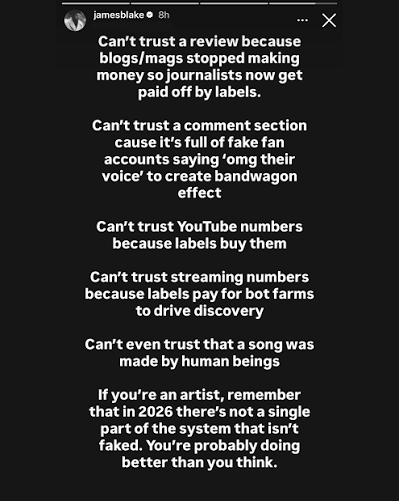
When James Blake posted that there isn't a single part of the music industry left untouched by manipulation, it struck a nerve with artists across the industry. His argument was straightforward: reviews can be influenced, comment sections can be manufactured, streaming numbers can be inflated and even the music itself is increasingly difficult to separate from artificial intelligence. For many musicians, particularly those operating independently, the post wasn't controversial. It simply put into words what many have been feeling for years.
The reality is that trust has become one of the most valuable and scarce commodities on the internet. A decade ago, seeing an artist rack up millions of streams or followers was enough to convince most people that they had genuinely broken through. Today, those same numbers are often met with scepticism. Audiences have become conditioned to question everything. Was the growth organic? Was the engagement paid for? Was there a marketing budget behind it? The assumption is no longer that success is real until proven otherwise. Increasingly, it's the opposite.
What's important to understand is that this issue extends far beyond music. The internet as a whole is going through what could be described as a trust crisis. Social media platforms are filled with content designed to maximise engagement rather than authenticity. Algorithms reward attention above all else. Artificial intelligence can generate content at a scale that would have been unimaginable just a few years ago. As a result, consumers are becoming more cautious about what they believe and who they trust. Music is simply experiencing the same wider cultural shift.
The economic climate is also playing a significant role in shaping how people consume music. Much of the generation currently driving online culture has spent years navigating rising living costs, expensive housing markets and increasing financial pressure. For many people in their twenties and thirties, disposable income is shrinking while uncertainty continues to grow. That inevitably changes consumer behaviour. People become more selective with their spending, but they also become more selective with their attention. Time itself becomes a valuable resource.
When audiences are under pressure financially, they tend to gravitate towards things that feel meaningful. This is one of the reasons why community-driven movements continue to outperform many heavily marketed campaigns. People aren't simply looking for songs anymore. They're looking for connection. They want artists they can relate to, stories they can follow and communities they can be part of. In a world that increasingly feels artificial, authenticity becomes more valuable.
This is where independent artists may actually have an advantage, despite all the obstacles they face. Major labels will always have bigger budgets, larger marketing teams and stronger industry connections. They can buy visibility in a way most independent artists never can. However, visibility and loyalty are not the same thing. A label can put an artist in front of millions of people, but it cannot force those people to care. Genuine connection remains one of the few things that cannot simply be purchased.
For years, independent artists have been told to chase numbers. More streams, more followers, more views, more engagement. Yet many of those metrics are becoming increasingly meaningless as audiences lose confidence in what they represent. The artists who appear to be winning are not always the artists creating the strongest foundations. Meanwhile, there are independent musicians quietly building dedicated fanbases, selling tickets, moving merchandise and creating sustainable careers without ever appearing on a major playlist.
The future may belong less to artists who chase attention and more to those who create worlds around their music. The most successful independent creators increasingly understand that music itself is only one part of a larger ecosystem. Fans want experiences. They want community. They want a reason to stay engaged between releases. Whether that's through exclusive content, events, websites, games, forums or direct interaction, the artists who give people something to belong to are often the ones creating the strongest long-term relationships.
James Blake is right to highlight the flaws in the current system. There are legitimate questions surrounding manufactured engagement, artificial growth and the increasing difficulty of determining what is genuine online. However, his post can also be interpreted another way. If audiences trust traditional signals of success less than ever before, then the playing field may not be as tilted as it once appeared.
The music industry remains difficult, competitive and often frustrating. Independent artists face challenges that shouldn't be ignored. Yet the same cultural shifts that are undermining trust in traditional industry metrics are also creating opportunities for artists who can offer something real. In an age of algorithms, bots and artificial influence, authenticity has become a competitive advantage. Ironically, the very factors that make the modern music industry feel broken may end up being the reason independent artists are finally able to build something stronger than ever before.